
We thought we’d be at Amy’s parents’ house for one week.
Three weeks later, we were still there.
We’d had two departure dates come and go. Every time we thought we had things under control, something else happened.
Amy’s mom, Gail, is 83 and completely physically disabled, although mentally very much with us. She’s bed/chair bound and requires help with virtually everything. During our first two weeks there, she’d been to the ER three times because of a severely swollen foot. No resolution. She also doesn’t have a primary care physician overseeing her care.
Amy’s dad, Elwood, is 88. He’s been Gail’s primary caregiver for years, but his own health was deteriorating. He initially refused medical care. Eventually, he went to the doctor for a UTI.
Then things took another turn.
While I was back in New Hampshire for a medical procedure, Amy found her dad in his bedroom, writhing in pain, with bloody feces all over the bedroom and bathroom.
Naked, too. No daughter ever wants to see THAT!
She called 911.
Elwood spent six days in the hospital, needed two blood transfusions, and came home with a Foley catheter.
Meanwhile, we were arranging home aides, coordinating cleaning and sanitation, managing medications, meals, groceries, and trying to figure out how to keep two medically complicated people safe.
We arranged care from 8 a.m. to 8 p.m. But not every aide knew Gail’s needs or how to care for her. So when someone new arrived, we had to stop what we were doing and provide an orientation.
You can imagine how relaxing that was.
We’d breathe a sigh of relief when an aide showed up who had been there many times before.
Eventually, we arranged 24-hour care for two days and escaped to New Hampshire. We needed a break. Not a few hours. Not an afternoon.
A month would have been nice.
Amy was drowning.
And honestly, I was exhausted, too.
When One Thing After Another Becomes Your Everyday Life
Elwood has been Gail’s primary caregiver for YEARS. Gail requires four full-body weight transfers every day. Someone has to get her dressed and undressed, get her sitting up, and help with EVERYTHING.
He’s done an honorable job. But the reality is, he can’t do it anymore.
A visiting nurse has stated that he cannot care for himself, let alone Gail. They both likely need assisted living.
Who tells them?
And how do we make that happen?
We live in a camper. We have plans to leave New England. Moving in with her parents is NOT an option. Ever.
Yet we’re the ones managing so many of the things that need to happen right now. And we can’t keep doing it this way.
We’re not just trigger-stacked. We’re living in a state of chronic stress overload.
One demand follows another. Before we have a chance to recover from the last problem, we’re hit with the next one.
Decision-making becomes harder. Patience wears thin. Emotions become harder to regulate. Even ordinary tasks can feel insurmountable.
You don’t get to finish dealing with one thing before something else demands your attention.
And when that becomes your everyday existence, your nervous system doesn’t get much opportunity to recover.
You’re emotionally and physically depleted. You’re operating in survival mode.
Sound familiar?
Your Reactive Dog May Be Experiencing Something Similar
Let’s bring this back to your dog.
If your dog is barking, lunging, and growling on your daily walk, she’s experiencing stress. And if those encounters happen repeatedly, without enough opportunity to recover, that stress can begin to accumulate.
Think about what’s happening inside her body.
When your dog encounters something she perceives as threatening or stressful, her sympathetic nervous system activates.
Adrenaline and noradrenaline help prepare her for immediate action. Think fight or flight.
Cortisol is part of a slower stress-response system. It helps mobilize energy and regulate the body’s response to stress.
These systems are important. They’re designed to help your dog respond to challenges.
The problem isn’t that your dog experiences stress. The problem is when stressful experiences keep piling up without enough time to recover between them.
Her nervous system can remain on high alert. Over time, repeated overwhelming experiences can contribute to increased sensitivity, hypervigilance, and difficulty disengaging from things that worry her.
Now think about your dog’s everyday routine.

Many doggie daycares can be high-stress environments, particularly when they’re overcrowded, have lots of activity, and provide little opportunity for rest.
Still walking your dog around dog parks?
Taking her to big box stores such as Petco or Home Depot?
If your dog already struggles with other dogs, people, movement, and unfamiliar environments, these outings may be adding to her stress load rather than helping her become more comfortable.
If your dog is already overwhelmed, more exposure isn’t necessarily the answer.
More Exposure Isn’t Always Better
Think about it this way.
If you’re emotionally exhausted, would adding more social engagements, more errands, and more demands help you recover?
Probably not.
Yet this is exactly what we often tell reactive dog owners to do.
Take your dog out more. Socialize her. Give her more opportunities to get used to other dogs and people.
I used to recommend more exposure, too. But NOT NOW!
Exposure isn’t automatically positive. It depends on how your dog experiences it.
If those experiences are repeatedly overwhelming, you may be adding to the very stress you’re trying to resolve.
Sometimes, doing less is the first step toward doing better.
How Do You Give Your Brain a Break?
When Amy and I finally got away for a couple of days, I knew exactly what I needed.
I wanted to retreat to our camper, our home, where no one was asking for anything and I could exhale.
And Netflix on the couch.
Not just any Netflix. I wanted movies or shows I’d already seen. Nothing new. Nothing that required my brain to process a lot of information or figure things out.
My brain needed predictability.
When we’re overwhelmed, familiar routines and fewer demands can help reduce the mental load. We don’t have to figure out what’s coming next or make another decision.
We can just be.
These same principles can help your dog.
Your dog’s brain learns through patterns and associations. Predictable routines can reduce uncertainty because your dog has a better idea of what comes next.
Predictability is good.
Your Reactive Dog Needs Netflix on the Couch, Too
Many reactive dogs need a break from the situations that keep them stuck in an emotional dysregulation cycle.
That’s why the first phase of my Revealing Your Dream Dog: Ditch the Reactivity, Not the Dog program is called Netflix on the Couch.
It’s a temporary decompression period.
We’re not talking about keeping your dog inside forever, giving up walks permanently, or avoiding every possible trigger for the rest of her life.
We’re talking about temporarily removing some of the situations that keep her stressed so her nervous system has an opportunity to recover.
Here’s what that looks like:
- Potty walks only. Keep them short and, preferably, close to home.
- Take a break from doggie daycare. Especially if your dog finds that environment overwhelming.
- Stop the walks that repeatedly trigger your dog. No more putting her in situations where she’s barking, lunging, and struggling to cope.
- Skip the shopping centers, Home Depot, and dog parks for now. Your dog doesn’t need more exposure just for the sake of exposure.
Instead, provide relaxing activities that engage her natural behaviors without adding more stress.
Give Your Dog Something Productive to Do
One of my favorites is scatter feeding.
It’s super easy.
Take a handful of dog food, show your dog your hand, and let her watch you toss the food onto the lawn.
If your yard isn’t fenced in, you can use a long line under direct supervision in a safe area. Avoid unattended tie-outs that could become tangled or create an injury risk.
Let your dog hunt for her food.
She’s using her nose, searching, and foraging. These activities engage natural motivation and reward systems. Dopamine plays an important role in motivation, anticipation, and learning. It helps drive your dog to seek out experiences and repeat behaviors that have been rewarding.
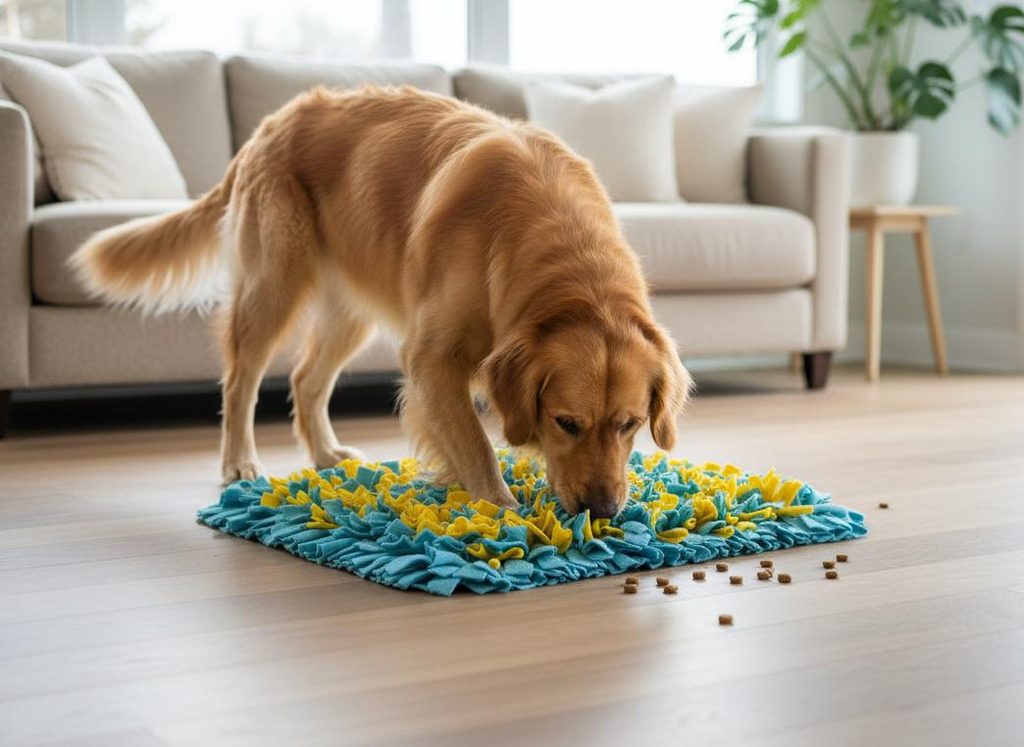
You can also introduce some food puzzles and enrichment toys.
- Kongs
- Licky bowls
- Snuffle mats
- Food puzzles
Here are a couple of examples:
Give her appropriate things to chew on, too, such as bully sticks, pig ears, or other suitable chews.
The goal isn’t to exhaust your dog with more activities. It’s to offer calm, enjoyable ways to spend her time while reducing the stressors she’s been dealing with.
And don’t underestimate the value of simply letting your dog relax.
First, Give Your Dog a Chance to Recover
It’s difficult for a dog who’s overwhelmed and on high alert to learn new coping skills.
We need to reduce the stress load before we can expect her to handle challenging situations differently.
This is exactly what Amy and I needed to do.
We had to get out of the pressure cooker to give our nervous systems a chance to recover.
Two days away helped me tremendously. But the reality is that Amy needs more time.
When we return, we’ll be in a better mental state to make phone calls, sort through the long-term care options for her parents, and deal with the decisions ahead.
And your dog needs that same opportunity to recover before you ask her to tackle the things she finds difficult.
You can’t keep adding stress and expect your dog to become less stressed.
Netflix on the Couch is just the first step. Once your dog has had an opportunity to decompress, we can begin working on the underlying issues, building coping skills, and helping her navigate the world more comfortably.
You don’t have to keep adding more exposure, more activities, and more training to make progress.
Sometimes, the most important thing you can do is give your dog a chance to breathe.
And sometimes, doing less really is doing more.


